Short answer: Plan a competition by locking in your bookings first: the start and end dates, the hours you have each night, how long each game runs including changeover, and how many fields or courts you have. Those numbers tell you how many games fit in a night, and every game takes two teams, so they set your team cap before you open registrations. From there, pick an even number of teams per division, a round robin that fits your dates, and a playoff format that keeps every team playing to the last week.
What do you need before planning a competition?
You need five numbers from your venue bookings: the start date, the end date, the hours you have each night, how long each game runs including changeover, and how many fields or courts you have. Every later decision, from team numbers to playoffs, depends on them, so confirm them in writing with your venue before you plan anything else.
- Start date. The first night you have the fields or courts.
- End date. The last night you have them, which is also the latest your playoffs can finish.
- Daily window. The hours you have them each night, for example 4pm to 8pm.
- Game length and changeover. How long each game runs and how long teams need to swap over, for example 25 minute games with 5 minutes between them.
- Number of fields or courts. Each one runs its own column of games through the night.
Count the actual nights between your start and end dates, then take out public holidays, school holidays if your players are juniors, and any nights the venue has blocked out. That count is the length of your season, and it is usually shorter than the calendar suggests.
How long should each game be?
For adult social competitions, we recommend two 18 minute halves with a 2 minute half-time and 2 minutes between fixtures, which is a 40 minute slot. Shorter games fit more teams into a night but draw more complaints and lose more teams between seasons. Junior game lengths are often set by your governing body, and games under 30 minutes rarely need a half-time.
Game length is the decision with the biggest knock-on effect. Longer games mean fewer slots each night, which means fewer teams and fewer registrations, so it is tempting to squeeze games down to fit more in. In our experience that trade usually costs more than it earns.
Why do longer games keep adult teams coming back?
For adult competitions we prefer two 18 minute halves with a 2 minute half-time and 2 minutes between fixtures. That is a 40 minute slot with 36 minutes of play. You fit fewer teams into each night, but you get far fewer complaints about short games, and teams are more likely to enter again next season.
Retention is the number worth protecting. A team that comes back is a spot you don't have to fill, and a full division at the start of every season is worth more than a few extra slots in one season. Research on junior sport points the same way: the Aspen Institute's Project Play survey found the most common reason kids quit a sport is that it stopped being fun, and nobody enjoys a game that ends just as it gets going.
How long is half-time in soccer?
Under the Laws of the Game, half-time can run up to 15 minutes, and competition rules must state its length. U.S. Soccer's youth standards set 10 minutes for 7v7 and 9v9 games. On a weeknight booking, community competitions usually run half-time at 2 to 5 minutes, because every minute of half-time comes straight out of the slot.
Games under 30 minutes usually don't need a half-time once players are over 9 or 10 years old. Running them straight through buys back a few minutes in every slot. It is your call as the organizer, and some competitions keep a short break for drinks in hot weather.
How long is a youth soccer game?
Youth game length depends on age and your governing body. U.S. Soccer's small-sided standards set four 10 minute quarters up to U8, two 25 minute halves at U9 and U10, and two 30 minute halves at U11 and U12. Football Australia's MiniRoos formats set two 20 minute halves up to Under 9 and two 25 minute halves at Under 10 and 11, with at least 5 minutes of half-time.
| Age group | Football Australia MiniRoos | U.S. Soccer standards |
|---|---|---|
| Under 6 to Under 8 | Two 20 minute halves | Four 10 minute quarters |
| Under 9 | Two 20 minute halves | Two 25 minute halves |
| Under 10 | Two 25 minute halves | Two 25 minute halves |
| Under 11 | Two 25 minute halves | Two 30 minute halves |
| Under 12 | Not covered by MiniRoos | Two 30 minute halves |
How long should changeover be between games?
Changeover is the time between one game's final whistle and the next game's kickoff. Teams leave, the next two step on, and someone records the score. Two minutes works for adult games when the next teams are warmed up and waiting at the side. Allow more for juniors, bigger fields, or a referee who needs to move between games. When the changeover is left out, games start late by the third slot and the last game of the night runs past your booking.
How long is a futsal or indoor game?
Under the futsal laws, a match is two 20 minute periods with the clock stopped whenever the ball is out of play, and the Laws of the Game set two 45 minute halves for 11-a-side. Both let competition rules shorten games, and most community indoor and futsal competitions play 20 to 36 minute running-clock games so more games fit into a night.
| Game format | Play time | Half-time | Changeover | Slot length |
|---|---|---|---|---|
| Adult, two 18 minute halves | 36 min | 2 min | 2 min | 40 min |
| Social, 25 minutes straight through | 25 min | None | 5 min | 30 min |
| Short social, 20 minutes straight through | 20 min | None | 5 min | 25 min |
| Junior, two 20 minute halves | 40 min | 5 min | 5 min | 50 min |
How many teams can you fit in one night?
Divide the minutes in your nightly window by your slot length to get games per field or court, multiply by the number of fields or courts, then double it, because every game takes two teams. A 4pm to 8pm booking on two fields with 30 minute slots fits 16 games, which is 32 teams each playing once a night.
Take a 4pm to 8pm booking on two fields, which gives you 240 minutes on each.
| Slot length | Games per field | Games across two fields | Teams playing each night |
|---|---|---|---|
| 25 min | 9 | 18 | 36 |
| 30 min | 8 | 16 | 32 |
| 40 min | 6 | 12 | 24 |
| 50 min | 4 | 8 | 16 |
Moving from 30 minute slots to 40 minute slots on that booking costs 8 teams a night, which is one full division. That is the real price of longer games, and with the numbers in front of you it becomes a clear choice between more teams this season and happier teams next season.
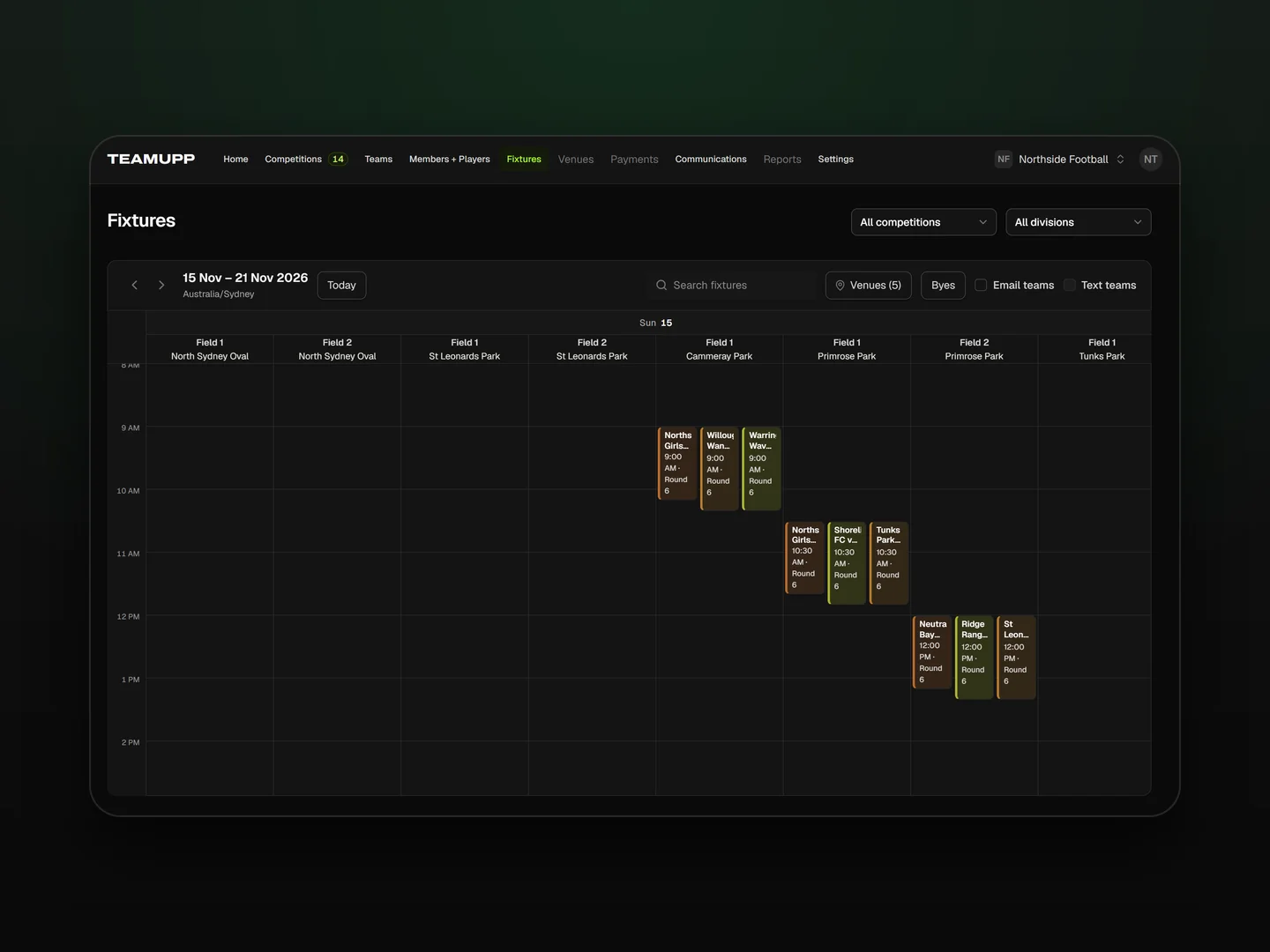
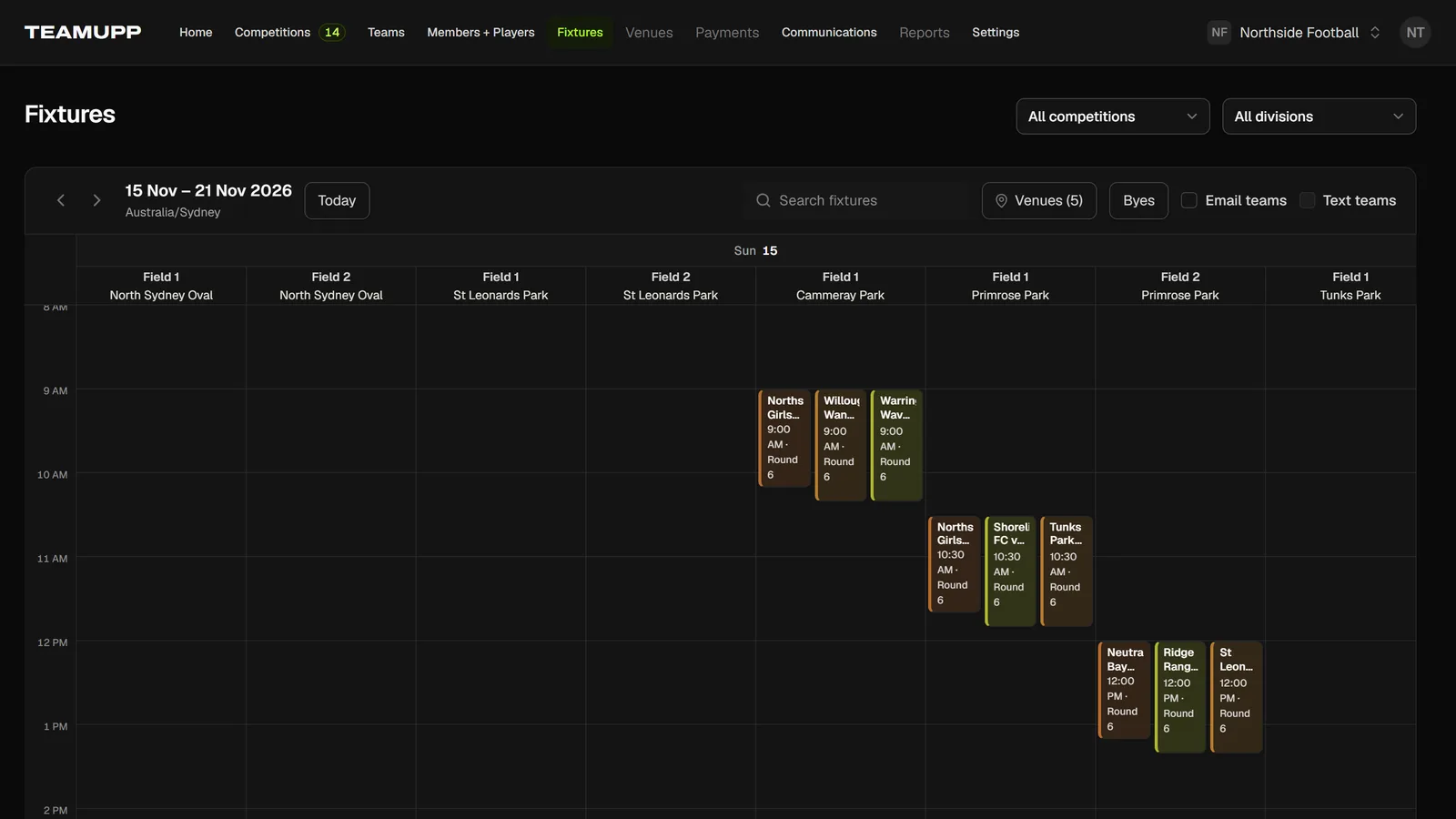
Laying every field against every time slot is the quickest way to see whether a night works. The scheduling calendar in TeamUpp shows each venue and field as a column, so empty slots and late finishes stand out before you publish.
How many teams should each division have?
An even number, usually 6, 8 or 10, so every team plays every round and nobody gets a bye. Eight teams is the most common shape: a 7 round single round robin plus a playoff round fits a 10 week booking with a spare night. Split your nightly capacity into divisions by age, gender or standard, and each division plays its own round robin with its own standings.
What is a bye?
A bye is a round where a team has no game, which happens whenever a division has an odd number of teams. An even number of teams per division is usually best, because a bye feels like a night that team paid for and didn't get. Byes and short games are the two complaints we hear most, so planning them out early saves a lot of messages later.
Most competitions we see run 8 teams over 7 weeks, so every team plays every other team once, followed by a playoff round. It is a popular shape, but there is no rule that says you have to use it.
How does a round robin tournament work?
In a round robin tournament every team plays every other team, once in a single round robin or twice in a double round robin. Teams earn points for each result, commonly 3 for a win, 1 for a draw and 0 for a loss, and the final standings decides the placings or seeds the playoffs. With an even number of teams everyone plays each round, and with an odd number one team sits out each round with a bye.
How many games are in a round robin?
A single round robin has the number of teams multiplied by one fewer than that, halved. 4 teams play 6 games over 3 rounds, 5 teams play 10 games over 5 rounds, 6 teams play 15 games over 5 rounds, 8 teams play 28 games over 7 rounds and 10 teams play 45 games over 9 rounds. The table covers every round robin format from 4 to 12 teams.
| Teams | Rounds | Games per round | Games per team | Byes per team | Total games | Double round robin games |
|---|---|---|---|---|---|---|
| 4 | 3 | 2 | 3 | 0 | 6 | 12 |
| 5 | 5 | 2 | 4 | 1 | 10 | 20 |
| 6 | 5 | 3 | 5 | 0 | 15 | 30 |
| 7 | 7 | 3 | 6 | 1 | 21 | 42 |
| 8 | 7 | 4 | 7 | 0 | 28 | 56 |
| 9 | 9 | 4 | 8 | 1 | 36 | 72 |
| 10 | 9 | 5 | 9 | 0 | 45 | 90 |
| 12 | 11 | 6 | 11 | 0 | 66 | 132 |
- Total games in a single round robin is the number of teams multiplied by one fewer than that, halved. 8 teams play 8 × 7 ÷ 2 = 28 games, and a double round robin doubles it.
- Rounds are one fewer than the number of teams when it is even, and equal to the number of teams when it is odd.
- Games per round are half the number of teams, rounded down, which is also how many slots each round needs.
What is a double round robin?
In a double round robin every team plays every other team twice, so 8 teams play 14 rounds and 56 games. It suits longer seasons where you want more games without adding teams. In our own competitions we have run 14 round seasons with 8 teams this way, and 9 round seasons with 9 teams, where every team gets exactly one bye. The right format is whichever fills your dates with the most games and the fewest byes.
How do you run a soccer tournament with 6 teams in one day?
Run a 6 team round robin: 15 games over 5 rounds of 3 games. On three fields every round plays at once, so with 15 minute games and 5 minutes of changeover the round robin takes five 20 minute slots, about 1 hour 40 minutes. Add a championship game and placement games for the other teams and the playing time is about 2 hours, plus breaks, presentations and setting up.
On two fields the same 15 games need 8 slots, so the round robin alone takes about 2 hours 40 minutes. Work out the length of any one-day tournament the same way: total games divided by fields, rounded up, multiplied by your slot length.
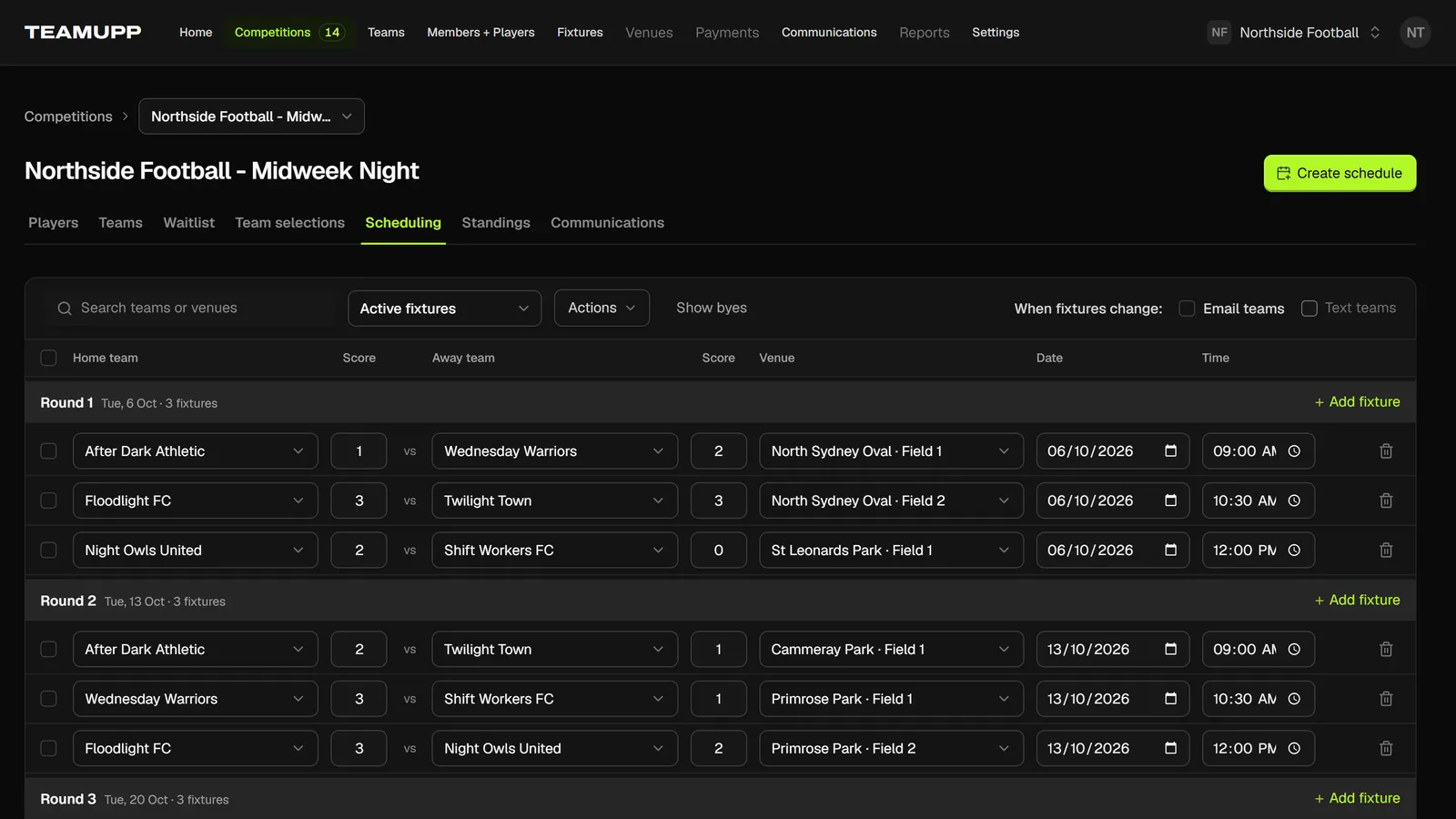
The round robin tournament article covers the math in more depth, and our round robin generator builds the rounds for any number of teams, byes included. In TeamUpp the rounds land straight on dates, venues and times, ready to adjust by hand.
How do you fit the rounds to your dates?
Add your round robin rounds, your playoff weeks and your spare night, then check the total against the nights you counted at the start. A 10 week season fits 8 teams in a single round robin over 7 rounds, two playoff weeks and a spare night. An 18 week season fits the same 8 teams in a double round robin over 14 rounds, two playoff weeks and two spare nights.
If the numbers don't fit, you have three levers to pull. You can change the number of teams in each division, switch between a single and a double round robin, or add or drop a playoff week.
When should you cap each division?
Set the cap on each division from your capacity math before you open registrations, and send any extra teams to a waiting list. Teams fill the divisions you planned, and a team that withdraws early is replaced from the list without reshuffling the schedule.
What does it cost to run a competition?
The main costs are venue hire, referees, insurance, any governing body levies or affiliation fees, trophies and equipment, plus payment processing on registrations. Add them up for the whole season, divide by the number of teams, and you have the minimum fee per team before any margin. In our own competitions, venue hire and referees have always been the two biggest lines.
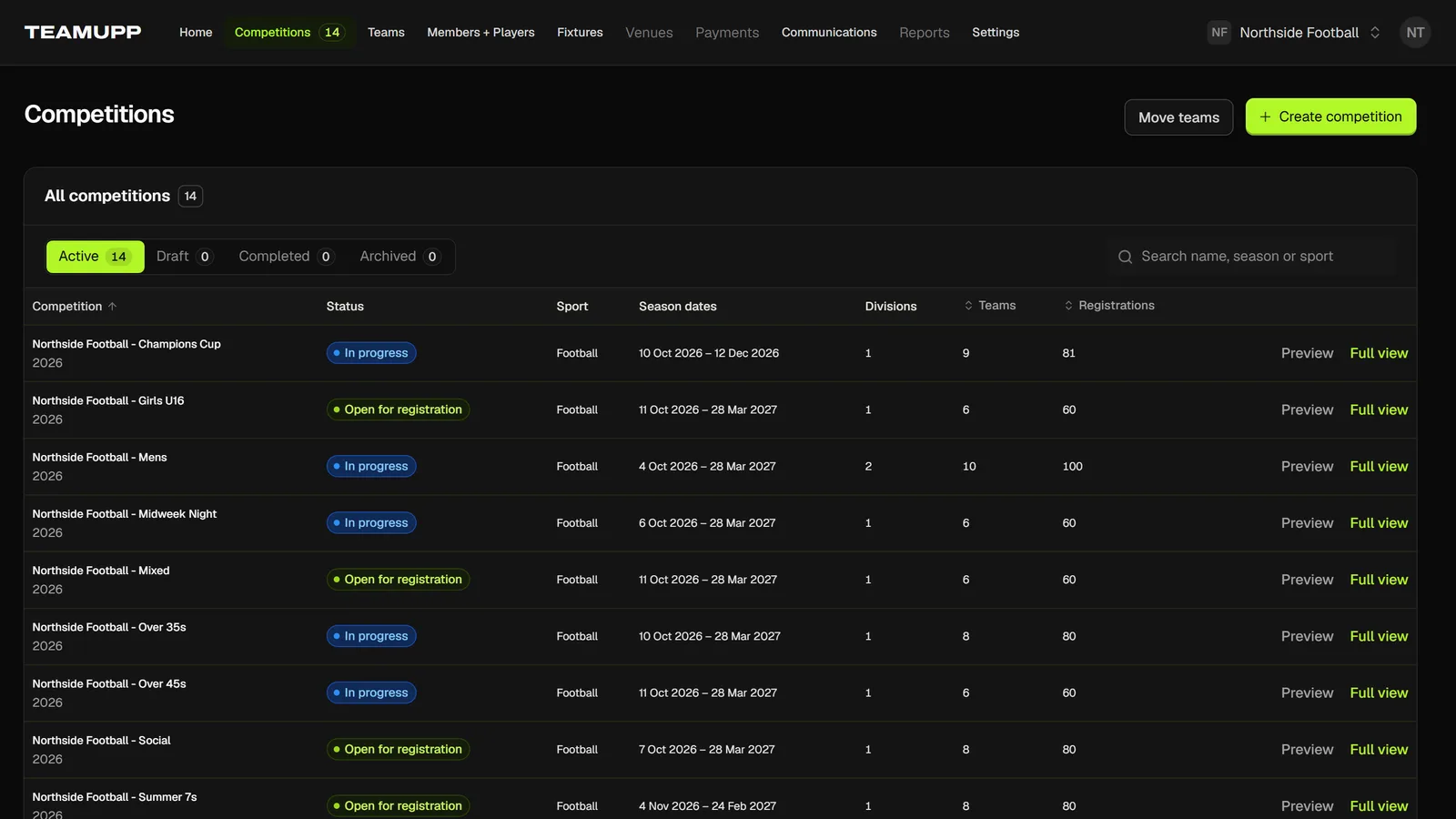
- Venue hire. Charged per hour for each field or court, so your booking hours from the start of this guide set the number.
- Referees. Usually paid per game, so the total is games in the season multiplied by the fee per game.
- Insurance. Public liability cover for the competition, and check whether players need personal accident cover through a governing body.
- Levies and affiliation. Some governing bodies charge a per-player levy, such as a provincial association fee. Collect it at registration so it never comes out of your margin.
- Trophies, balls and bibs. Small per season, but they add up across divisions.
- Payment processing. Card fees on every registration, which you can build into the price you set.
How much should you charge per team?
Divide your total season cost by the number of teams, then add your margin and a buffer for teams that withdraw. Price per team for the whole season rather than per game, and collect it in full at registration, so a team that drops out halfway has already paid for its spot. Check your fee against other competitions nearby before you publish it.
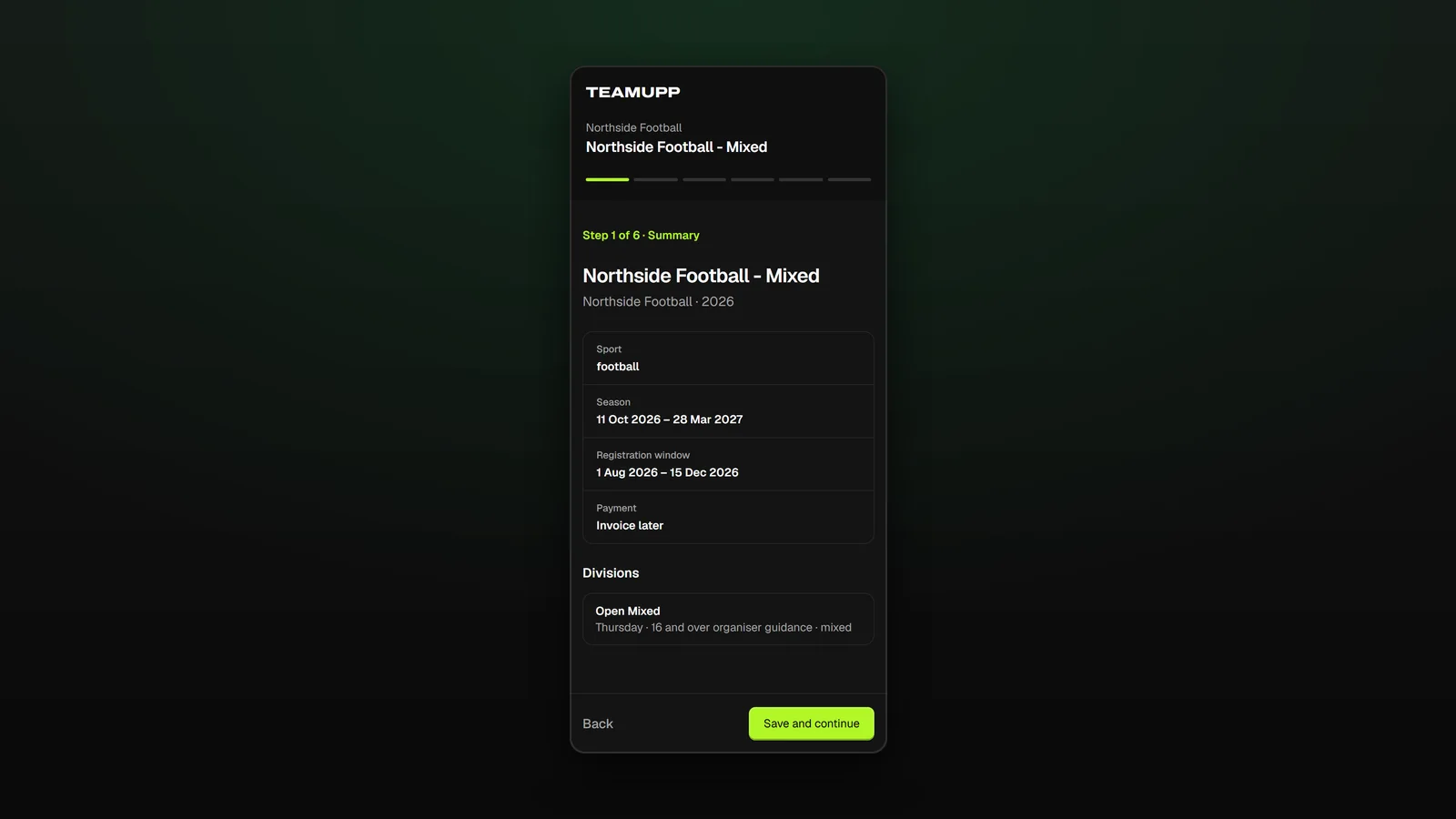
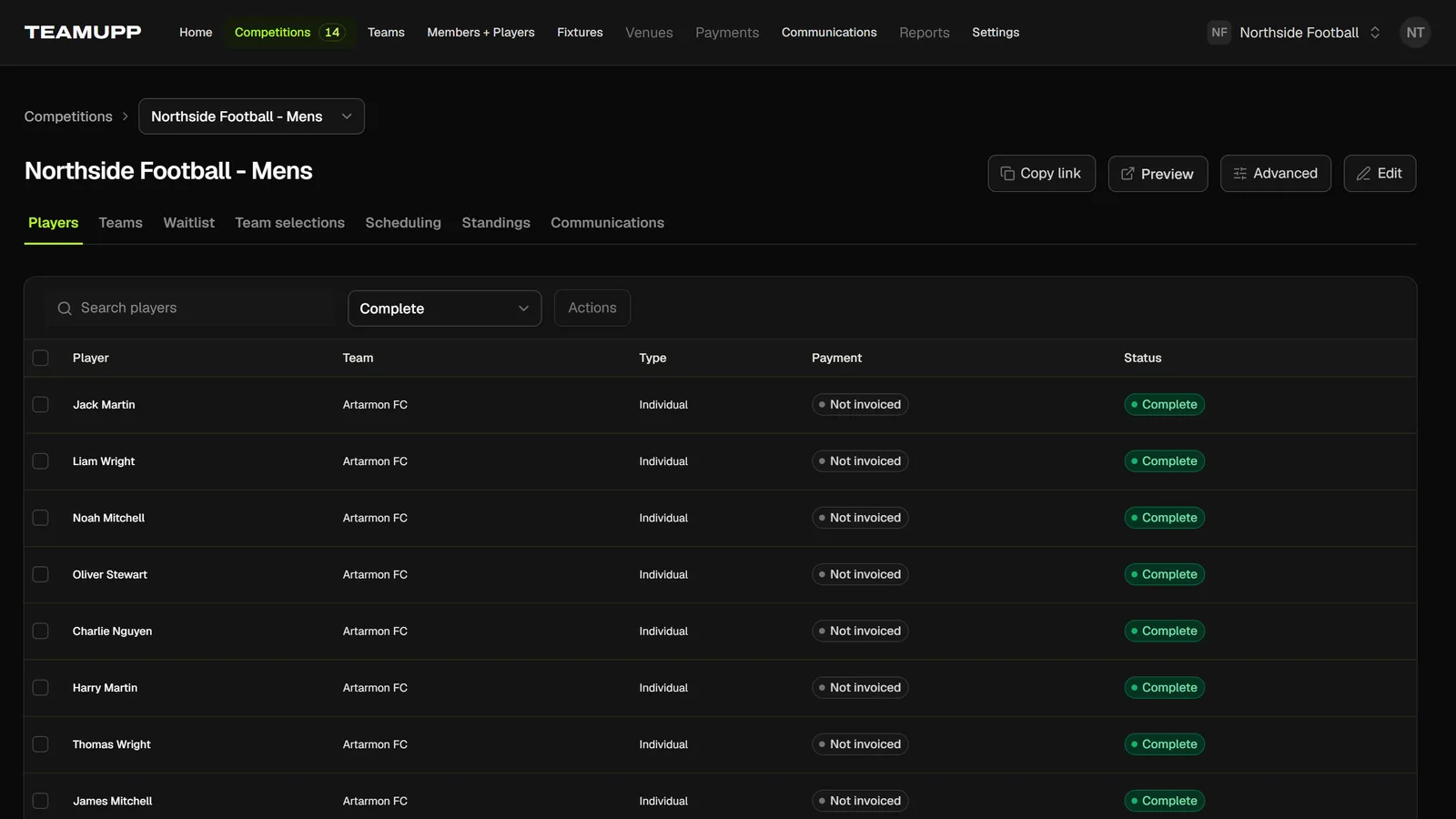
Each extra team in a division adds games, and each game adds a referee fee and a slot of venue time, so rework the numbers whenever a division grows. With registrations in TeamUpp, a governing body levy can be split to its own account at checkout, and every unpaid team is visible in one table.
How do standings work?
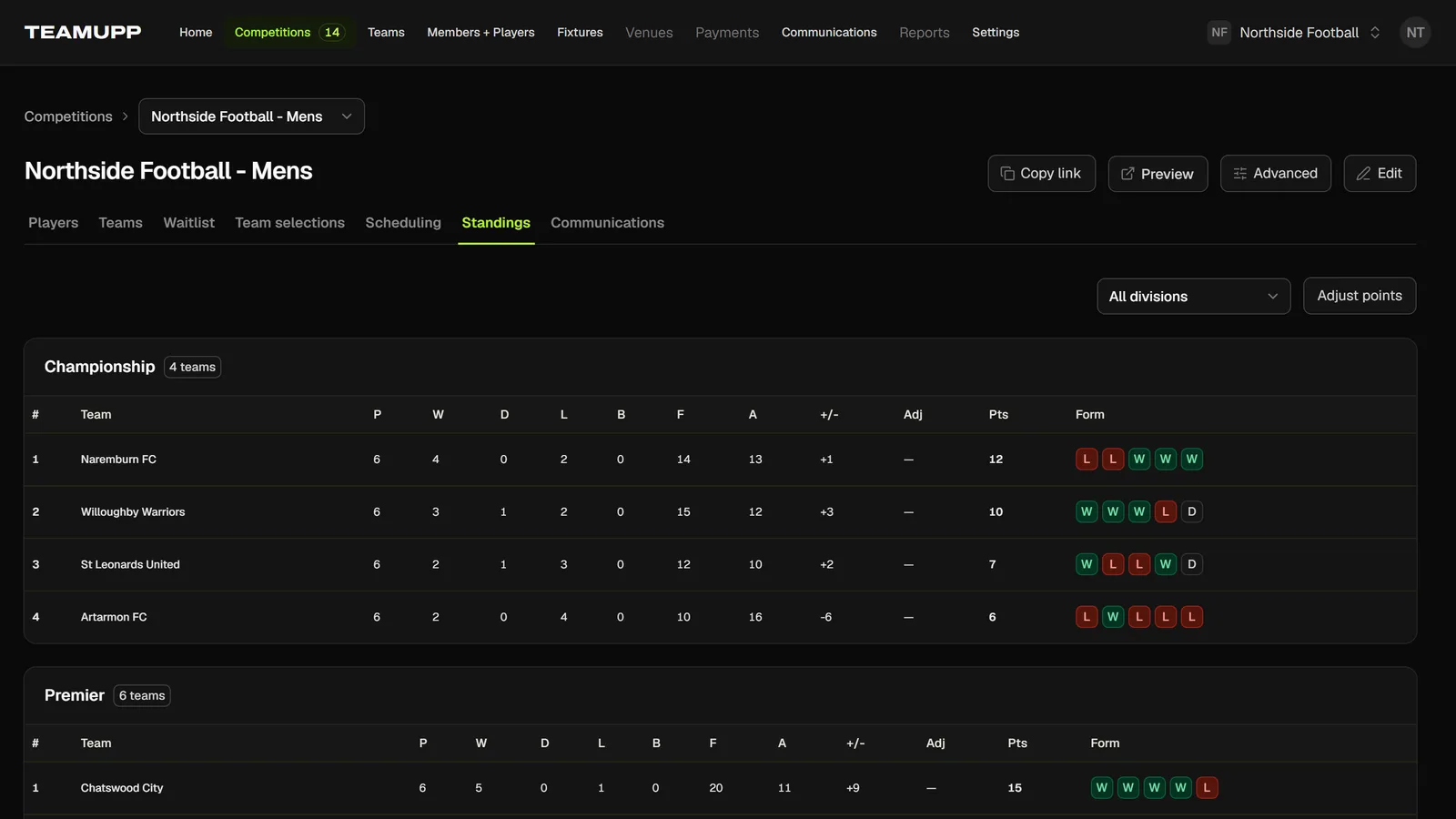
Standings rank teams by points, commonly 3 for a win, 1 for a draw and 0 for a loss. Teams level on points are separated by tiebreakers your competition rules set, most often goal difference, then goals scored, then the results between the tied teams. The usual columns are played, won, drawn, lost, goals for, goals against, goal difference and points.
Publish your tiebreakers before the season starts. The tiebreaker only matters at the end of the season, when two teams are level and both think they finished higher, and a rule written down in round 1 settles it in a sentence.
How do you make standings in a spreadsheet?
Make one row per team in Excel or Google Sheets with columns for played, won, drawn, lost, goals for, goals against, goal difference and points. Goal difference is goals for minus goals against, and points are 3 times wins plus draws. Sort by points, then goal difference, then goals for. It works for one division, but every result is typed in by hand and re-sorted each week.
Our free league table maker builds the standings from results, and in TeamUpp the standings update themselves as scores come in.
Which playoff format should you use?
Use knockout playoffs or the Page playoff when the title is what teams play for, and playoffs for every team when retention matters most, because the whole division keeps playing to the last week. A single playoff round suits short seasons and tight bookings. Whichever you choose, plan its weeks into your season dates before registrations open.
The playoff format decides how many teams are still playing in the last weeks of your season. That matters for retention, because a team whose season ends three weeks before everyone else's is a harder team to sign up again.
How do knockout playoffs work?
The top four play semifinals, 1st against 4th and 2nd against 3rd, then the winners meet in the championship game. It is familiar and the stakes are clear. The trade-off is that half of an 8 team division has finished before the playoffs start. Our bracket generator draws the bracket once the standings is final.
How does the Page playoff system work?
The Page playoff system gives the top two teams a second chance. 3rd plays 4th and the loser is out, while 1st plays 2nd and the winner goes straight to the championship game. The loser of that game then plays the winner of 3rd against 4th for the other spot. It takes three weeks and rewards the teams that finished on top, which is why it has been common in Australian playoffs since the 1930s.
What are playoffs for every team?
Every team plays in the playoffs, matched against teams that finished near them on the standings. The top four play their own semifinals and championship game, the bottom four play theirs, and bigger divisions keep splitting into groups of four. This is sometimes called a placement or consolation bracket. Teams at the bottom still have a trophy to play for, and every team plays the same number of games.
What is a single playoff round?
After the round robin, 1st plays 2nd for the title, 3rd plays 4th, 5th plays 6th and 7th plays 8th, all on the same night. It fits a short season, needs only one week, and gives every team a final game that means something.
| Format | Weeks needed with 8 teams | Teams playing in the last week | Best for |
|---|---|---|---|
| Knockout, top four | 2 | 2 | Seasons where the title is what teams play for |
| Page playoff, top four | 3 | 2 | Rewarding the top two over a longer season |
| Playoffs for every team | 2 | 8 | Social competitions where retention matters most |
| One playoff round | 1 | 8 | Short seasons and tight bookings |
Can an AI assistant plan it with you?
Paste this prompt into ChatGPT, Claude, Gemini or the AI assistant you already use. It walks the assistant through this guide step by step and has it ask you every question the guide raises, so you finish with a plan built on your own bookings and teams.
Prompt to plan your competition
You are helping me plan a soccer competition. Use the TeamUpp guide at https://teamupp.com.au/ca/guides/competitions/how-to-plan-a-football-or-futsal-competition as your method, and read it first if you can open links.

Work through the steps below in order. Ask me one group of questions at a time, wait for my answers, and show your working before you move on. If I am unsure, give me the guide's recommendation and the trade-off.

1. Bookings. Ask for my venue, the first and last nights I have the fields or courts, any nights that are blocked out (public holidays, school holidays, venue events), the hours I have each night, and how many fields or courts I have.
2. Players. Ask who is playing: age groups, adult or junior, social or competitive, and whether a governing body sets junior game lengths for me.
3. Game length. Recommend a game length, half-time and changeover, explain the trade-off between fitting more teams and playing longer games, and confirm my choice. Then tell me my slot length.
4. Capacity. Calculate games per field or court each night, games across all my fields or courts, and how many teams can play each night. Round down, and make sure the last game finishes before my booking ends.
5. Divisions. Ask how I want to group teams (age, gender, standard) and suggest division sizes, preferring an even number of teams in each division so nobody gets a bye.
6. Rounds. For each division, compare playing each other once with playing each other twice, and show rounds, games per team, byes per team and total games.
7. Playoff format. Explain knockout playoffs, the Page playoff, playoffs for every team and a single playoff round. Ask what my teams care about most, then recommend one.
8. Fit check. Count the nights I can play and check that the rounds, playoff weeks and one spare night all fit. If they don't, suggest which lever to change first.

Finish with a one-page plan: a table of divisions with team numbers, rounds, playoff format and season dates, the start time of every slot on each field or court, and a list of decisions I still need to make. List any assumptions you made.
Already have a plan? Use this one to have your assistant check it against the guide and point out what to fix first.
Prompt to check an existing plan
I already have a plan for my soccer competition. Check it against the TeamUpp guide at https://teamupp.com.au/ca/guides/competitions/how-to-plan-a-football-or-futsal-competition.

Check the capacity math for each night, flag any division with an odd number of teams, flag game lengths short enough to draw complaints, confirm every round and final fits before my end date with a spare night, and list the changes you would make in order of impact. Ask me for anything missing before you answer.

My plan (bookings, game length, half-time, changeover, divisions, rounds and playoff format):
What are the steps to plan a competition?
There are eight steps, in this order: confirm your bookings, count your nights, set your slot length, work out your team cap, split it into divisions, choose your round robin and playoff format, set your fee, and cap each division before registrations open. Each step uses the numbers from the one before, so skipping ahead usually means coming back to redo it.
- Confirm your start date, end date, nightly window and number of fields or courts.
- Count the nights you can play, minus holidays and blocked dates, and keep one spare.
- Set game length, half-time and changeover, then add them up to get your slot length.
- Work out games per night and double it to get your team cap.
- Split the cap into divisions, with an even number of teams in each where you can.
- Choose a single or double round robin, then a playoff format, and check it all fits your nights.
- Add up your season costs and set a fee per team that covers them.
- Set each division's cap before registrations open, with a waiting list for extra teams.
With those numbers settled, TeamUpp builds a schedule across your fields or courts, checks for clashes before you publish, and updates the standings as scores come in. If you are starting from scratch, our guide on how to start a soccer league covers sanctioning, registrations and payments.
Questions organizers ask
How many teams can I fit into one night?
Divide the minutes in your booking by your slot length, multiply by the number of fields or courts, then double it because every game takes two teams. A 4pm to 8pm booking on two fields with 30 minute slots fits 16 games, which is 32 teams playing once each.
How long should games be in a social competition?
For adult competitions we recommend two 18 minute halves with a 2 minute half-time and 2 minutes between fixtures, which is a 40 minute slot. Shorter games fit more teams, but they bring more complaints and fewer teams entering again next season.
How long is half-time in soccer?
The Laws of the Game allow up to 15 minutes, and competition rules must set the exact length. U.S. Soccer's youth standards use 10 minutes, while weeknight community competitions usually run 2 to 5 minutes so more games fit in the booking.
How long is a youth soccer game?
It depends on age and your governing body. U.S. Soccer's standards set four 10 minute quarters up to U8, two 25 minute halves at U9 and U10, and two 30 minute halves at U11 and U12. Football Australia's MiniRoos formats set two 20 minute halves up to Under 9 and two 25 minute halves at Under 10 and 11.
How long is a futsal or indoor game?
Under the futsal laws a match is two 20 minute periods with the clock stopped when the ball is out of play, and competition rules can shorten it. Social futsal and indoor competitions usually play shorter running-clock games, such as 25 minutes straight through or two 18 minute halves, so more games fit into a night.
How many rounds does a round robin need?
With an even number of teams, a single round robin needs one fewer round than there are teams, so 8 teams play 7 rounds and 28 games. With an odd number, it needs as many rounds as there are teams, and every team gets one bye.
What is a double round robin?
A double round robin has every team play every other team twice. 8 teams play 14 rounds and 56 games, which suits longer seasons where you want more games without adding teams.
What is a bye in sports?
A bye is a round where a team has no game, usually because the division has an odd number of teams. In a round robin with an odd number of teams, every team gets exactly one bye.
Which playoff format is best?
It depends on what your teams play for. Knockout playoffs and the Page playoff suit seasons built around a title, while playoffs for every team keep the whole division playing to the last week, which helps more teams come back next season.
How many games are in a 6 team round robin?
A 6 team single round robin has 15 games over 5 rounds, with 3 games each round and 5 games per team. A 6 team double round robin has 30 games over 10 rounds.
What is the best round robin format for 5 teams?
A 5 team single round robin has 10 games over 5 rounds, with 2 games each round. Every team plays 4 games and has one bye, so add a sixth team if you can to remove the byes.
How long does a one-day soccer tournament last?
Divide the total games by the number of fields, round up, and multiply by your slot length. A 6 team round robin on three fields with 20 minute slots takes about 1 hour 40 minutes, and about 2 hours with playoffs, before breaks and presentations.
How much does it cost to start a soccer competition?
It depends on your venue, referees, insurance and any governing body fees, and venue hire and referees are usually the biggest costs. Add up the season's costs, divide by the number of teams, and add a margin and a buffer for withdrawals to set your fee per team.
Sources
- Law 7, the duration of the match (IFAB Laws of the Game)
- Futsal Laws of the Game, Law 7 (The FA)
- MiniRoos national playing formats and rules (Football Australia)
- Player development initiatives and small-sided standards (U.S. Soccer, via US Youth Soccer)
- Survey of why kids quit sport by age 11 (Aspen Institute Project Play)
- Round robin tournament (Wikipedia)
- Page playoff system (Wikipedia)
Written by the TeamUpp team from six years of running community soccer competitions and tournaments in Australia. Rules and game lengths checked against the governing body sources above. Last updated . Add TeamUpp as a preferred source on Google.