Short answer: Run each night as its own comp, take paid team entries with a waiting list, build a draw across your courts and publish a ladder parents and players can check.
Run each night as its own league
Treat each night as a separate competition with its own teams and its own table. Players think of it as their night, not a division.
Count your courts and time slots first. That number, not demand, sets how many teams each night can hold.
Take the whole team's fee up front
Let a team manager enter the team and pay in one go, then invite players with a link.
When a night fills, send new teams to a waiting list instead of turning them away.
If your players register with a federation, check its fees for social and futsal players. Football Victoria, for example, sets a 2026 social and futsal fee of $30 for juniors and $40 for seniors.
Build a court-by-court grid
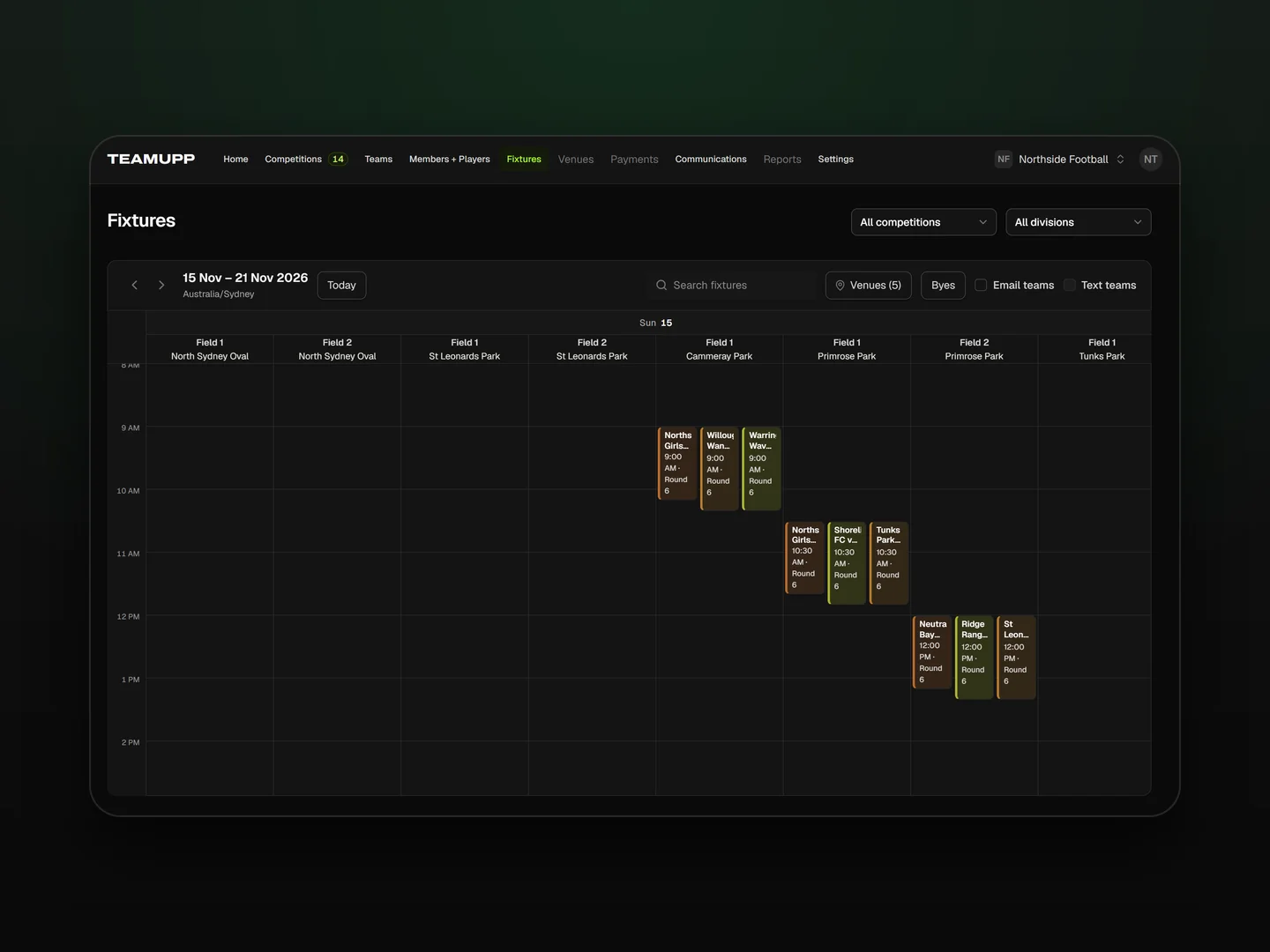
Generate a round robin for each night, then place every game on a court and a time slot.
Swap courts by hand when a team asks for an earlier game, and check for clashes before you publish.
Keep the ladder current
Most soccer competitions give 3 points for a win, 1 for a draw and none for a loss. Write this into your rules before round one, along with how you'll break a tie on points.
Tiebreakers differ by competition. Football Queensland uses goal difference first, then head-to-head points, then head-to-head goal difference.
Enter scores on the night so the table is right before players get home.